Joseph Crowe
Speaker System No.2800
Speaker System No.2800
Couldn't load pickup availability
Atelier Inventory — Available Now
A pre-owned pair of Speaker System No.2800 has recently returned to Crowe through our trade-in program and is now available from inventory.
This pair has been inspected and tested by Crowe and is offered at 28% below the regular made-to-order price. Preferred pricing applies exclusively to this pair.
Available for audition at our Picton, Ontario showroom by appointment. National and international shipping is available.
Speaker System No.2800
A reference-level horn loudspeaker combining high sensitivity and effortless dynamics with natural tonal character, exceptional soundstage depth and an enveloping sense of acoustic space.
Designed and built by Crowe in Picton, Ontario, Canada, Speaker System No.2800 is a three-way high-sensitivity loudspeaker that brings together horn loading, controlled room interaction, precision CNC machining and extensive acoustic measurement. Its design is intended to preserve the immediacy and dynamic freedom for which large horn systems are known while presenting music with tonal smoothness, spatial precision and long-term listening comfort.
With 95dB anechoic sensitivity, the No.2800 can achieve realistic listening levels with very little amplifier power, making it particularly well suited to high-quality low-powered tube amplification. At the same time, 200-watt continuous power handling and a maximum output capability of 118dB allow the system to make use of considerably more powerful amplification when required.
This combination allows the No.2800 to move easily between intimate, low-level listening and music reproduced at realistic scale, maintaining nuance and texture while providing exceptional transient impact and dynamic range.
Horn Architecture
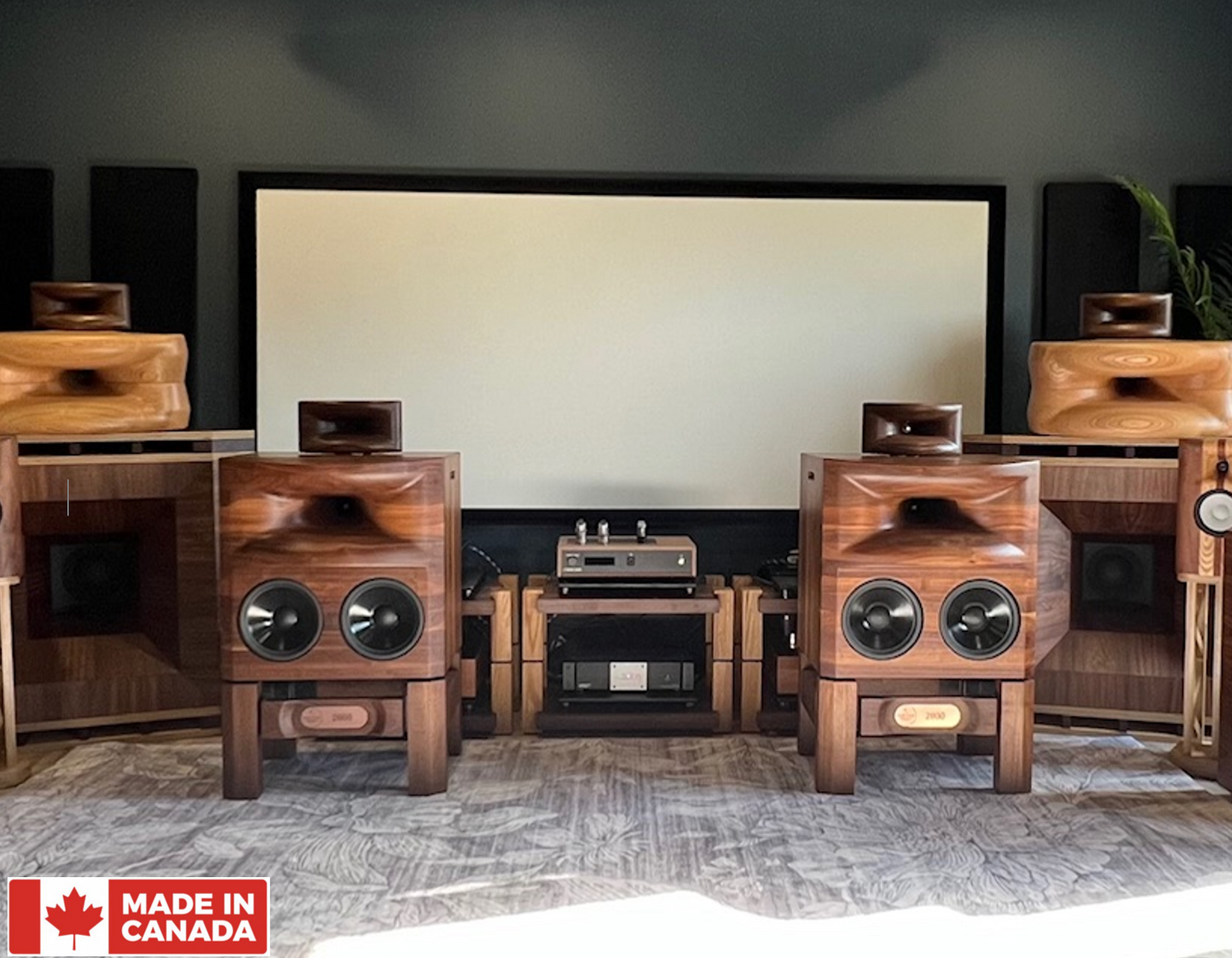
The ES-450 biradial midrange horn forms the acoustic and visual centre of the No.2800. Instead of mounting a separate horn to a conventional enclosure, the ES-450 and front baffle are CNC machined together from solid walnut as one continuous component.
The integrated construction allows the horn geometry, cabinet structure and sculpted form of the loudspeaker to function as a unified design. A modified B&C DCM50-8 2-inch compression driver operates through the ES-450, providing high acoustic efficiency, very low diaphragm excursion and the effortless dynamic behaviour that defines much of the character of the No.2800.
A dedicated top-mounted high-frequency horn completes the upper range while also serving an important second purpose in the system's spatial radiation design.
Time Alignment, Phase & Soundstage Depth
The No.2800 was developed with particular attention to spatial reproduction. The objective was not simply to establish accurate left-to-right imaging, but to preserve the timing information necessary for voices and instruments to appear at convincing positions and depths within the recorded acoustic.
The midrange and high-frequency sections are acoustically time aligned and cross over at 2kHz using symmetrical crossover slopes. Maintaining this controlled timing and phase relationship through the crossover region contributes to stable localization, precise image focus and the exceptional soundstage depth of the No.2800.
Ideally, the listener is not conscious of separate horns or individual drive units. Instead, the system presents a continuous acoustic space in which performers can occupy clearly defined positions in front of, between and beyond the physical loudspeakers.
Controlled Dipole Operation
Spatial reproduction in the No.2800 extends beyond the direct sound. The system deliberately employs dipole operation to introduce a controlled amount of rear radiation into the listening environment.
This reflected energy arrives indirectly and contributes to the perception of openness, spaciousness and acoustic scale, while the forward radiation remains responsible for precise image localization. Rather than attempting to remove the listening room entirely from the reproduction process, the design uses an intentional balance of direct and reflected sound.
The amount of rear energy is chosen to enhance spatial perception without producing an exaggerated ambient effect. With appropriate placement, this allows the apparent acoustic environment to extend beyond the loudspeaker boundaries while preserving the focus and depth produced by the time-aligned direct sound.
Elevated Reflections & Listener Envelopment
The orientation of the No.2800's top-mounted high-frequency horn is equally deliberate. Its primary axis is positioned at proper ear height, while the top surface of the bass cabinet establishing a primary reflection point above the listener’s head providing rear wall reflected energy into the room.
This approach is closely aligned with the body of psychoacoustic research discussed extensively by Floyd Toole, in which room reflections are not regarded as inherently detrimental. When a loudspeaker maintains well-controlled radiation and appropriate spectral character away from its primary axis, reflected energy can contribute positively to the perception and enjoyment of reproduced music.
Two spatial attributes are particularly relevant: apparent source width (ASW) and listener envelopment (LEV). They describe, respectively, the perceived breadth of the reproduced source and the extent to which the listener experiences the surrounding acoustic field as enveloping. Direction, arrival time and level of reflected energy all contribute to these perceptions.
The elevated reflection from the upper horn works in conjunction with the No.2800's dipole radiation, adding another controlled spatial element to the system. There is a useful conceptual parallel with upward-firing immersive systems such as Dolby Atmos, where energy reflected from above the listener contributes to perceptions of height and envelopment. The No.2800 accomplishes this acoustically within a conventional two-channel system rather than through additional encoded audio channels.
Time-aligned direct radiation establishes image precision and soundstage depth, while controlled rear and elevated reflected energy contributes spaciousness, apparent source width and listener envelopment.
The intention is to retain precise focus when it exists in the recording while allowing music to develop the openness, scale and immersive quality associated with listening within a real acoustic environment.
Driver Materials Chosen for Sound Character
Measurement and engineering established the technical foundation of the No.2800, but the final choice of drive units was also made according to their sound character.
Different diaphragm technologies were considered during development. Ultimately, the system was configured around paper diaphragms in the woofer and midrange sections and a polyester diaphragm for the high-frequency section, because these materials provided the smooth and natural presentation sought for the completed loudspeaker.
They were deliberately selected over the metallic diaphragm materials commonly encountered in many high-efficiency loudspeaker and compression-driver designs. Every diaphragm material presents its own engineering compromises, but listening and development work consistently favoured the tonal character of paper and polyester in this particular application.
The objective is to combine the speed, sensitivity and dynamic freedom of horn loading with a presentation that remains smooth and relaxed. Detail and transient energy are preserved without encouraging the listener to focus on the loudspeaker itself during extended listening.
Low-Frequency Foundation
Low frequencies are reproduced by a pair of flagship 10-inch SEAS paper-cone woofers manufactured in Norway.
Operating within a dual-woofer, rear-ported enclosure, they extend the system response to approximately 30Hz while retaining the speed and dynamic behaviour necessary for natural integration with the horn sections. This provides substantial low-frequency authority without requiring the scale of enclosure normally associated with a large-format horn loudspeaker.
The No.2800 presents a nominal 4-ohm impedance, and its crossover network is designed so that the individual sections operate as a coherent full-range system rather than drawing attention to the transitions between drive units.
Solid Walnut Construction
Construction of the No.2800 draws as much from fine furniture and instrument making as it does from conventional loudspeaker manufacturing.
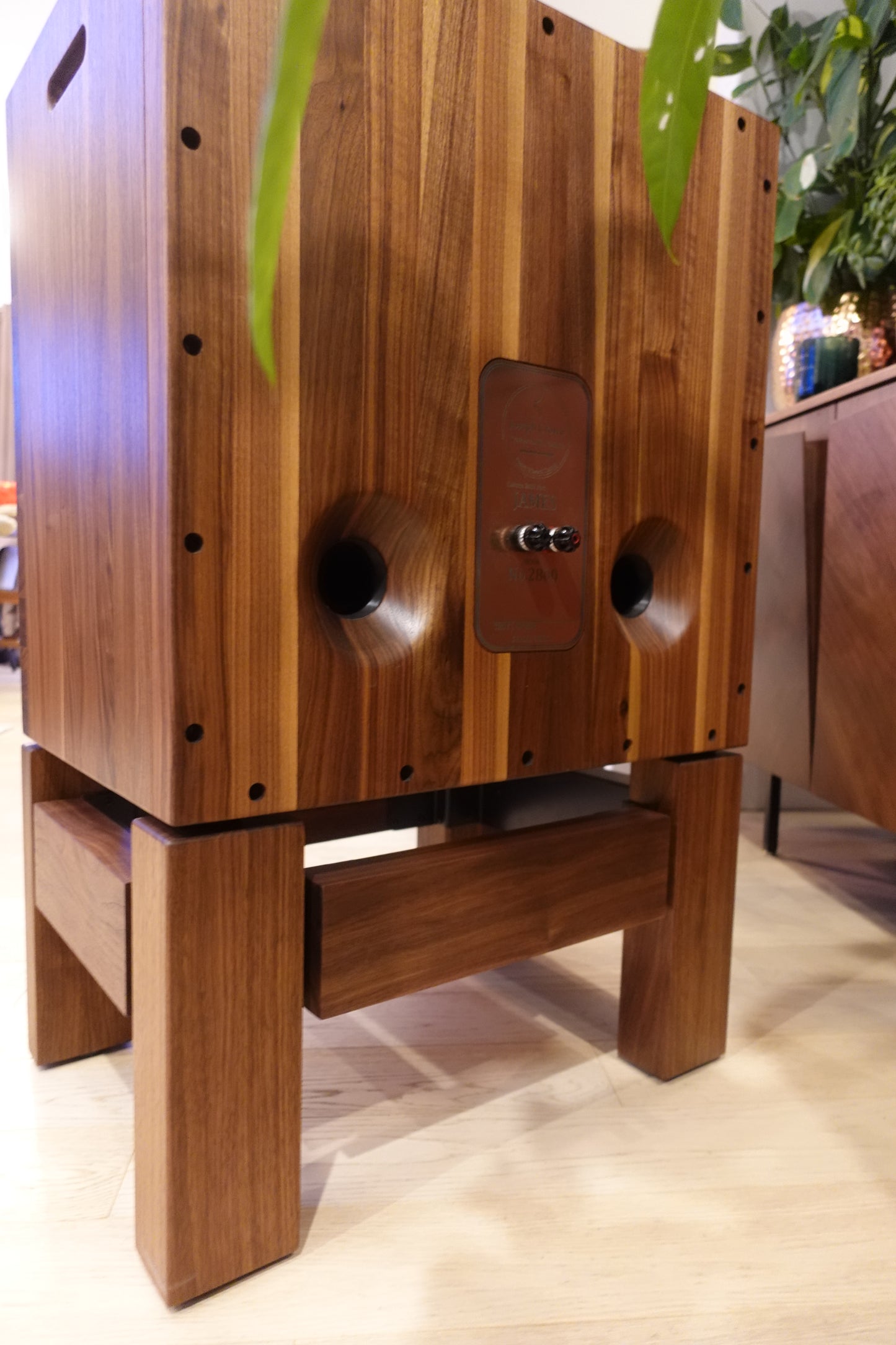
The cabinet is made from exceptionally substantial 35mm (1.38") solid walnut. Its sculpted front baffle and ES-450 horn are fully CNC machined from solid walnut as a single integrated component, producing a highly rigid acoustic structure while creating one of the defining visual characteristics of the design.
Every pair is built to order in our Picton atelier. Matching solid walnut speaker stands and premium WBT binding posts are included, together with a custom identification decal bearing the Troy Joseph Crowe signature and the customer's name.
Blue Note Award — Best at Toronto Audiofest 2025

Speaker System No.2800 received the Blue Note Award for Best at Toronto Audiofest 2025, recognizing the system's performance during its public exhibition.
Owner Experience
For an owner's perspective on the No.2800, the following review documents the experience of a customer who selected the system after owning and listening to a number of high-end loudspeakers.
Read the No.2800 customer review →
Specifications
- 3-way high-sensitivity loudspeaker system
- 95dB sensitivity (anechoic)
- 30Hz–20kHz frequency response
- 4 ohm nominal impedance
- 200W power handling
- 600W short-term power handling
- Maximum SPL: 118dB @ 1m (200W input)
- 2kHz time-aligned midrange/high-frequency crossover
- Symmetrical crossover slopes
- Controlled dipole radiation
- Elevated primary reflection from top-mounted high-frequency horn
Driver & Horn Configuration
- Dual 10" flagship SEAS paper-cone woofers, manufactured in Norway
- Modified B&C DCM50-8 2" paper-diaphragm compression driver
- ES-450 biradial midrange horn
- ES-800 biradial 1" high-frequency horn
- Custom polyester-diaphragm high-frequency compression driver
- Driver diaphragm materials selected specifically for smooth, natural tonal character
Construction
- 35mm (1.38") thick solid walnut cabinet construction
- Solid walnut front baffle and ES-450 horn machined as one integrated component
- Precision CNC-machined construction
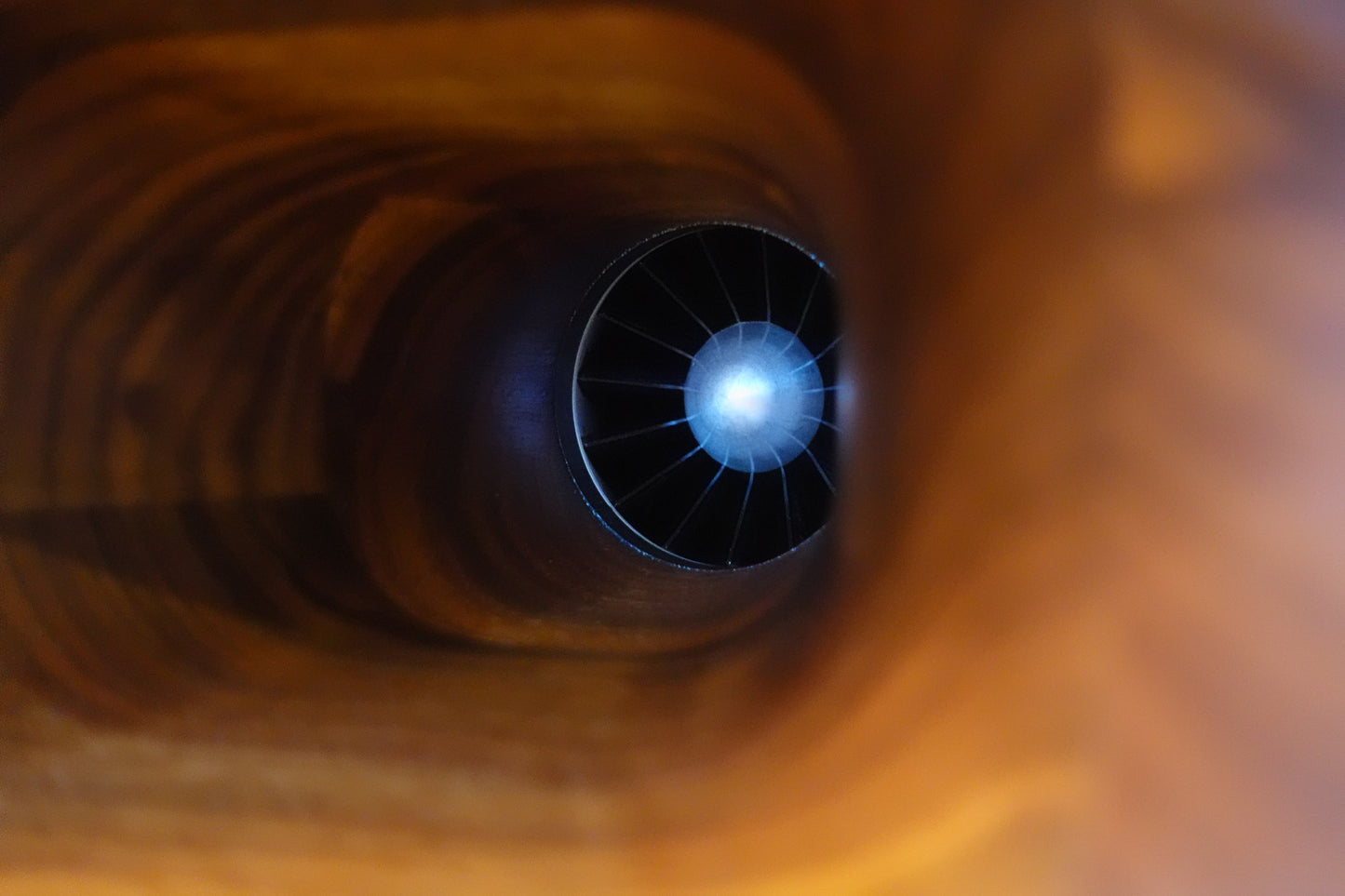
- Dual rear flared ports
- WBT binding posts
- Matching solid walnut speaker stands included
- Custom identification decal with Joseph Crowe signature and customer name
- Designed and built in Picton, Ontario, Canada
Dimensions
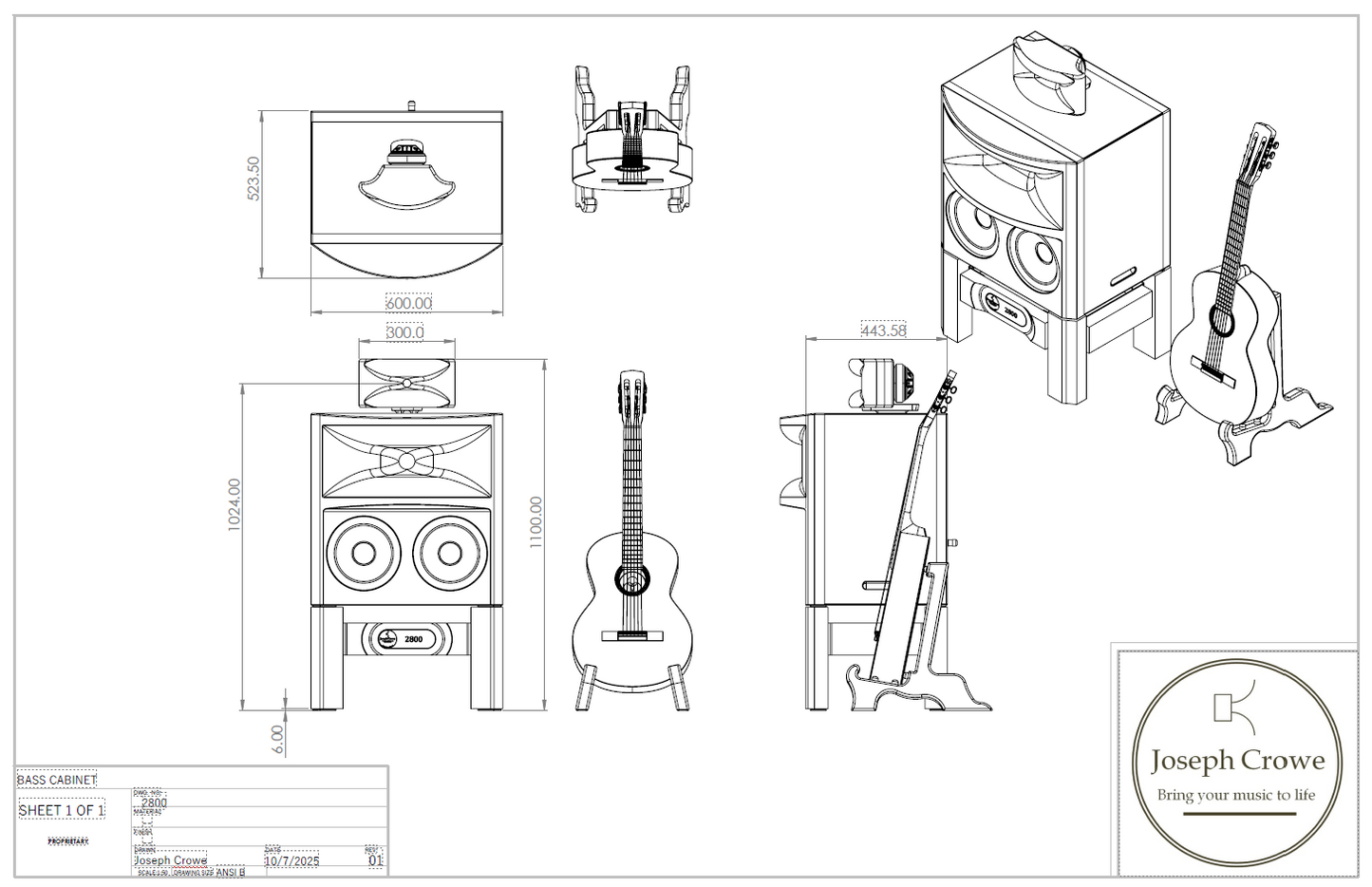
- 60cm W × 87cm H × 43.3cm D
- 23.62" W × 34.25" H × 17" D
Dimensional Drawing
Click the image below to view the dimensional drawing.

Details

Watch & Listen
Made to Order in Canada
Every pair of Speaker System No.2800 is built to order in our Picton, Ontario atelier. Our fixed-production approach allows each system to be produced directly by the people responsible for its design, machining, assembly and final acoustic verification.
For availability, finish options, audition appointments or assistance determining whether the No.2800 is appropriate for your listening room and amplification, please contact us directly.